
Upgrading legacy HVAC systems is no longer a future consideration; it is an immediate requirement for many building owners, operators and contractors. With the UK’s commercial building stock made up predominantly of existing properties (up to 80%), retrofit activity is now the primary driver of change across the sector, and a core commercial opportunity.
At the same time, rising energy costs and tightening carbon targets are accelerating the need to act. For many, the shift is not voluntary. Compliance with Building Regulations Part L (Conservation of Fuel and Power) is increasingly shaping decisions around plant replacement, system upgrades and long-term investment strategies.
In our latest Industry Spotlight technical article Chris Caton, Product Director – Commercial at Ideal Commercial Heating explores the evolving direction of the commercial heating sector as regulations and industry priorities increasingly focus on decarbonisation, electrification, intelligent controls and whole-system performance. While retrofit projects represent the greatest opportunity to reduce carbon emissions in existing buildings, he highlights the importance of balancing environmental ambitions with practical considerations, advocating for tailored, cost-effective solutions that meet the unique requirements of each building.
Download the full Industry Spotlight article: Ideal Commercial Heating Industry Spotlight How legacy HVAC systems are upgraded to meet Part L
Why is Part L driving HVAC upgrades in existing buildings?
Changes to Approved Document L represent a significant step towards the UK’s net zero ambitions. Heating and hot water alone account for around 21% of UK carbon emissions, making building services a critical focus area.
Part L has introduced stricter efficiency requirements, particularly around how energy performance is measured and delivered in both new and existing buildings.
While much of the attention has focused on new build, its impact on retrofit is arguably greater. Any meaningful upgrade or replacement of f ixed building services now requires compliance, meaning that even relatively simple plant replacements can trigger wider system changes.
One of the most influential changes is the requirement for heating systems to operate at a maximum flow temperature of 55°C.
This fundamentally alters how systems are designed and specified. It encourages condensing boilers to operate in their most efficient mode while also preparing buildings for heat pump integration by aligning with their optimal operating conditions.
While the 2021 uplift to Part L focused heavily on improving the efficiency of heating equipment, the latest 2026 edition broadens the conversation to include building-level
performance. Greater emphasis is now placed on primary energy consumption, operational carbon emissions, controls, commissioning and building automation systems. This reflects a growing recognition that even the most efficient plant can fail to deliver expected savings if systems are poorly designed, controlled or operated. For contractors, consultants and building owners, this means taking a more holistic view of building performance rather than focusing solely on individual products.
How will future standards change commercial HVAC design?
The current Part L requirements were always intended as a transitional step towards the Future Homes and Buildings Standard (FHBS), which will come into force f rom March 2027 for most new buildings in England. From that date, the new Part L 2026 framework will supersede the current requirements for new commercial buildings in England, delivering the non-domestic element of the Future Buildings Standard.
The result is a significant shift towards low-carbon, net-zero-ready buildings, with greater emphasis on electrification, building performance and operational efficiency.
Perhaps the most significant change is that new non-domestic buildings will be designed around low-carbon heating from the outset. In practice, this means heat pumps are expected to become the default heating technology for most new commercial buildings.
For existing buildings, however, the challenge is different. Most commercial buildings standing today will still be in use well beyond 2050. Consequently, building owners are increasingly looking to futureproof investment decisions by selecting heating systems that can deliver immediate efficiency improvements while supporting a longer-term pathway towards lower-carbon operation. This is one reason why hybrid systems are attracting growing interest across many sectors.
Why is retrofit more complex than a simple plant replacement?
Historically, upgrading a heating system often meant replacing an old boiler with a newer, more efficient model. Today, that approach is rarely sufficient. Retrofit projects now demand a whole-system perspective.
Improving building fabric is a key starting point, as more thermally efficient buildings require less heating input. However, this also introduces new challenges. Lower heat demand, combined with lower system temperatures, changes how emitters, pipework and controls need to be designed and operated.
As a result, system integration has become significantly more complex. Considerations such as electrical capacity, available space, capital and operational expenditure, and project timelines all play a role in determining the most appropriate solution.
This complexity means that retrofit is no longer about a single product. It is about delivering a coordinated system upgrade that balances performance, cost and compliance.
Are hybrid systems the most practical route to decarbonisation?
In many retrofit scenarios, hybrid systems are emerging as a pragmatic solution. While full electrification via heat pumps is often the long-term goal, real-world constraints can make this difficult to achieve immediately.
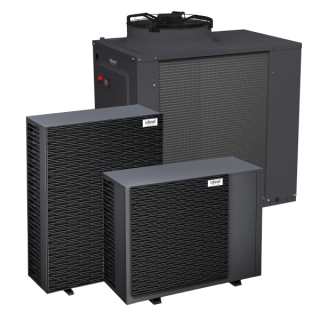
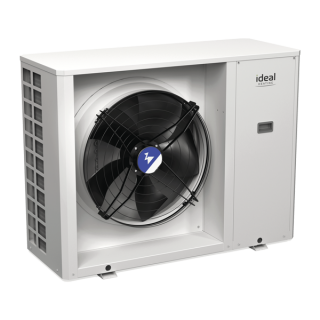
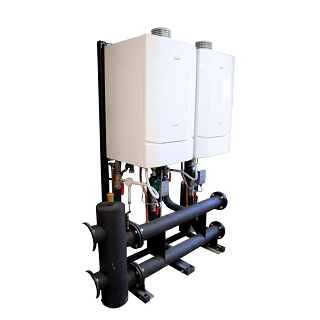
Hybrid systems, combining heat pumps with high-efficiency boilers, allow buildings to reduce carbon emissions while maintaining operational resilience. When correctly designed and commissioned, the heat pump provides the primary source of heat, with the boiler supporting peak demand and extreme conditions. Cascading wall hung commercial condensing boilers, such as our Evomax 2 or the floor standing Imax Xtra 2, are ideal for a hybrid system as a higher modulation ratio is achieved, so gas usage is far more efficient.
These have been designed to work seamlessly with our ECOMOD air source heat pumps in a hybrid scenario.
The growing use of hybrid solutions reflects a broader industry shift towards transitional technologies that enable decarbonisation without compromising practicality or affordability.
How important are controls, commissioning and system design?
As HVAC systems become more complex, the importance of controls and commissioning in system operational efficiency has increased significantly and has been recognised in the latest Part L guidance. It reflects an industrywide shift towards measuring real-world building performance rather than simply assessing installed equipment efficiencies.
Correct commissioning ensures that heat pumps, boilers and ancillary components work together effectively, delivering the intended balance between efficiency and performance.
In addition, innovations such as increased thermal storage, advanced building management systems and intelligent control strategies are becoming more common. By storing heat during off-peak periods, optimising plant sequencing and continually monitoring system performance, building operators can significantly reduce operating costs while improving carbon performance.
What role do contractors, consultants and suppliers play in retrofit success?
The shift towards more complex HVAC systems is changing the role of everyone involved in the supply chain. Knowledge and collaboration are becoming key differentiators.
Contractors and consultants must consider a wider range of factors earlier in the project lifecycle, from electrical infrastructure to long-term operational costs. Meanwhile, suppliers and manufacturers are increasingly expected to provide guidance and technical support, helping customers navigate the complexities of compliance and system design.
What does the future hold for legacy HVAC upgrades?
The direction of travel is now clearer than ever. The latest Part L guidance and the forthcoming Future Homes and Buildings Standard both point towards a future characterised by lower carbon heating, electrification, smarter controls, building automation and performance-based design. The industry’s focus is steadily shifting from individual products towards integrated systems that can demonstrate measurable operational efficiency throughout their lifecycle.
For now, retrofit remains the single biggest opportunity within the commercial heating sector. But this does not mean that every existing commercial building must immediately move to full electrification. For many projects, practical constraints outlined above will continue to influence system selection. The challenge for the industry is therefore not simply to decarbonise, but to do so in a way that is achievable, affordable and aligned with the needs of individual buildings.