
In our latest Industry Spotlight technical article, authored by Charlie Mowbray, Senior Product Manager, he explains how heat networks are becoming a vital part of the UK’s low-carbon heat strategy. However, many systems installed over a decade ago are now underperforming due to ageing infrastructure and inefficiencies. Replacing legacy HIUs on a distressed basis can be an efficient solution to upgrading a heat network.
Read the full Industry Spotlight technical article here: Ideal Commercial Heating Industry Spotlight Modernising Heat Networks
Heat networks are becoming a vital part of the UK’s low-carbon heating strategy. By distributing thermal energy from a central plant to multiple buildings, they offer an efficient, scalable alternative to individual gas boilers or heat pumps. When operating optimally, they reduce emissions, enhance resilience and lower energy costs. However, many systems installed over a decade ago are now underperforming due to ageing infrastructure and inefficiencies that were not anticipated at the time of design.
To support the upgrade of these underperforming systems, the UK government launched the Heat Network Efficiency Scheme (HNES). With capital and revenue grant funding available, subject to budget availability, HNES provides grant funding to public, private, and third-sector organisations for refurbishments.
While most attention tends to focus on modernising energy centres by introducing heat pumps, modern condensing boilers, or a hybrid system featuring both, the performance of Heat Interface Units (HIUs) must also be scrutinised, as they are crucial to how heat is delivered and used at the point of use.
Legacy HIUs and the impact on heat network efficiency
In many cases, poor network performance isn’t solely down to outdated boilers or plant equipment. A significant portion of the inefficiency arises from older HIUs that were installed before any formal test regime was in place. Without standardised testing like the UK HIU Test Regime, many of these early units were installed without clear expectations around their operational effectiveness.
These legacy HIUs often struggle to manage temperature control, offer limited adjustability, and are difficult to maintain. In addition, some manufacturers are no longer in business, meaning support and spares are either unavailable or not cost-effective. The consequence is high return temperatures, which reduce the efficiency of the entire system. Even when the core plant is upgraded, these return temperatures can undermine overall performance.
One increasingly popular approach is the replacement of HIUs on a distressed basis – replacing individual units as they fail, rather than undertaking a full-scale retrofit. This can be an efficient use of resources if new HIUs are compatible with the network’s design parameters, including flow and return temperatures and differential pressure.
Choosing modern heat interface units for retrofit applications
Modern HIUs are engineered to control return temperatures more effectively, which has a direct impact on system efficiency. They also provide better user control, improved hot water responsiveness, and are often designed for easier installation and ongoing maintenance. While laboratory testing can highlight small performance differences between units, in real-world applications, ease of installation, commissioning and serviceability can be just as critical as technical specifications. Poor commissioning or inaccessible components can negate the benefits of even the most technically capable equipment. Therefore, decisions around HIU selection should consider not only energy performance but also operational usability and long-term support from the manufacturer. Ideal Heating Commercial’s POD HIU offers a layout that prioritises access and usability, simplifying the installation and maintenance process.
The economics of heat interface unit replacement
The upfront cost of replacing HIUs – particularly across large estates – can be significant. However, many network operators are finding that the long-term benefits justify the investment. Poorly performing HIUs drive up energy consumption and generate frequent service requests. By upgrading to modern units, many institutions are seeing measurable efficiency gains, with payback achieved within favourable timescales. Beyond this period, the savings continue for the operational life of the equipment.
With funding support from HNES, organisations may be able to reduce the capital burden and justify upgrades based on data-driven projections. Housing associations, Energy service companies (ESCOs), and social landlords, in particular, are well positioned to benefit - especially where poor efficiency directly impacts operating costs and tenant comfort.
Future-proofing heat networks through strategic investment
Refurbishing heat networks isn’t just about fixing short-term problems. It’s about future-proofing infrastructure for a low-carbon future. While new heat networks will undoubtedly play a role in decarbonisation, there is a vast stock of existing systems that must be brought up to modern standards if the UK is to meet its emissions targets.
HIUs are fundamental to how a heat network performs. An inefficient HIU can undermine even the most advanced energy centre, leading to poor user experience and escalating operational costs. By investing in modern, certified, and serviceable units – supported by government funding where available – organisations can unlock efficiency improvements.
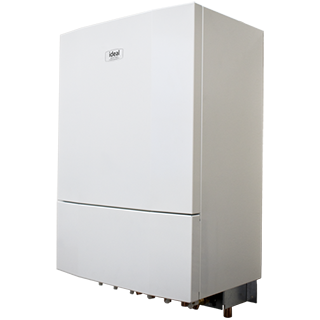
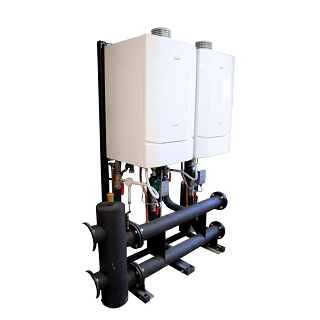
Read our Ash View Extra Care Case Study, where Ideal Commercial Heating has installed four Evomax 2 100kW wall-mounted boilers operating in cascade on a standard height frame and header kit as the energy centre, providing heat to 50 POD HIUs with first fix kits and factory-fitted hard-wired Mbus heat meters.